Thursday, April 21, 2022

Dusting off the bookshelf...again. (I promise.)

c. 2011 - Focus Features

Wow. It's been years, hasn't it? I can totally explain, as you've undoubtedly got questions about where I've been. 

Also, I've rebranded, because The Bookish Kind has kind of worn out its welcome as a name. Admittedly, that was a name that I came up with because I thought it was cute. I think I've finally come to the realization that it wasn't. 

So here we are: on the precipice of another reboot, and with a book that couldn't be more fitting. What's even funnier is I'm technically on vacation, and as a full-time entertainment journalist, writing may be something people would have considered the least likely thing I'd be doing on this trip.

Anyhow, consider this proof of life, and proof that I'm back in the world of book blogging. It's been a while, but it's good to be back. I might even start a vlog/podcast component to all of this eventually, but for now let's start out small. 

Hello again. I'm Mike Reyes, and from here on out, everything is going to be On The Books

Monday, May 21, 2018

Dusting The Bookshelf

This blog isn't dead... it's just been resting for four years or so.

Time to dust it all off, turn on the lights, and find a new damned name.

It all starts here...

Saturday, March 8, 2014

Cannonball Read VI: The Undiscovered Country - Entry 1, "Gone Girl" by Gillian Flynn

"...realized in beautifully damning prose, with an ending that made me so uneasy and upset, I realized hadn't felt that about a character in a while."

Fear is one of the most powerful emotions of the human psyche. It crashes our systems, lowers our defenses, and makes us act irrationally - all in the hopes that everything will turn back to normal, and the puzzle that is our fear will be solved into security. If someone can tap into this basest of emotions within us, we either praise them (when they do so for entertainment) or damn them (when they do so for our own suffering). I've experienced both, and now I've found a book that intersects both realms by taking a very real fear, and fictionalizing it. 

Nick and Amy Dunne are about to celebrate their fifth wedding anniversary, and things aren't exactly perfect. Within their years of marriage they've both been laid off, resigned to move from New York to Missouri (in order to take care of Nick's parents), and they might be starting to drift apart as a couple. As if this wasn't bad enough, Nick's about to be thrust into the limelight of a missing person's investigation, as this is also the day that his wife disappears without a trace. Front door open, living room slightly disheveled, and an anniversary present as the last remaining artifact - Nick and the police are going to have their work cut out for them. As the days pass, and the pieces start to fall into place, our protagonist will find his task growing in difficulty. And all throughout the events that come to pass, just one question bears repeating, as if the Universe were suggesting it become Mr. Dunne's new mantra... "Where's Amy, Nick?"

The reason I wrote a prologue describing the effects of fear is because Gillian Flynn's hit novel Gone Girl touches on one of my greatest fears. It does so in such an effective manner that by time I was finished with it, I sat deadly still in my chair. The finale was a culmination of my greatest nightmare, realized in beautifully damning prose with an ending that made me so uneasy and so upset, I realized hadn't felt that way about a character in a good long while. Never had I wanted a character to make it out unscathed so bad, and never had I wanted a character to die so much. 


This book drew me in, and made me question how it was going to sustain its length, only to drop twists that made its plot not only able to continue, but made it a requirement that it did so. Ms. Flynn's writing style made me feel like I was watching a perfectly paced TV show; complete with season arcs, episodic cliffhangers, and well fleshed out characters. (Being a former TV critic for Entertainment Weekly kinda helps with that sort of thing.) What I thought was going to be a tale with the surface level of suspense took a hard left turn early on, and kept making itself into a more claustrophobic house of mirrors. It is a modern Noir thriller that takes the momentum of the fun house finale in Orson Welles' The Lady From Shanghai, and sustains it for the latter two acts of the text.

With the movie on the way this fall (and pretty much a shoo-in for awards contention, should it live up to the promise of the prose), now is the best time to read Gone Girl. Not only is everyone going to want to read it before the film comes out, but they'll want to read it before it's possibly nominated for an Academy Award. If this film is half as good as the book is (keep in mind, David Fincher is directing, with Ben Affleck starring as Nick), then this is going to have a great day at next year's Oscars.

So do yourself a favor: read it before the movie comes out. Read it before it's hard to find a copy on shelves near you. Read it before everyone spoils it for you. Read it before the trailer possibly spoils it for you. Read it...before you know who finds you. 

Monday, December 16, 2013

Review: "Nerd Do Well: A Small Boy's Journey To Become A Big Kid", by Simon Pegg

Pages: 368 pgs
Audio Book Details: 4 hrs, 50 mins, Abridged, Read by The Author
Publisher: Gotham
SRP: $18.00
Release date: June 5, 2012

Author's Note: This review is of the Audio Book version.

Simon Pegg is a hypocrite. A celebrity who claims he didn't want to write a memoir went ahead and wrote a memoir. He cashed in! He took the bait! He...actually writes a memoir that's fun and good spirited, while actually keeping track of what a memoir should be. A pillar of Geekdom himself, Mr. Pegg has written not a typical Hollywood memoir of name dropping and self congratulations. He's actually written a memoir about how he got where he is, the people he befriended along the way, and the perils/pitfalls of growing up as a geek in the 1970's.

The book is written on two separate tracks: one details the adventures of Simon Pegg, Batman-esque superhero/master tinkerer/sex god, and his quest against the nefarious Lord Black and the sexy (if not morally ambiguous) Scarlett Panther. The other details Simon Beckingham (later changed to Pegg, after his Step-Father) and his journey through childhood, adolescence, and eventually adulthood. The former is a comic romp through an adventure that mixes all of the nerdy influences that Simon grew up with and still indulges in to this day, while the latter is his straightforward (but equally comic) life story. Both of these components compliment each other to the point where while you're enjoying one aspect playing out over Pegg's rather smooth vocals, you're still excited to switch off to the other track and get back to the thread that he left hanging oh so expertly.


Pegg's writing is a lot like the many projects he's written and acted in: a lot of geek humor and profanity/absurdity, mixed with actual emotional resonance and meaning. You can tell why he's worked so well with Edgar Wright and Nick Frost, besides the fact that he had pre-existing friendships with both before working with them on Spaced, Shaun of the Dead, Hot Fuzz, and most recently The World's End. What's even more impressive than his detailing his friendships turning into partnerships, or the pivotal moments in geekdom that forever influenced Mr. Pegg's work, is the accounts he provides when it comes to meeting his childhood idols. In fact this book flies in the face of the old saying, "Never meet your heroes", as Pegg not only did get to meet them, but in some cases has befriended them, worked with them, or even received endorsement from them. Never once is this played as anything more than Pegg being humble and awe struck, and never once is he bragging outside of the role of a geek that got to meet Carrie Fisher at Comic Con. He even awkwardly confesses that he used to kiss a poster of her in her Slave Leia outfit from Return of the Jedi, and the result is sweet if not hysterical.

I can't speak for the print version (though I am curious to visit it sometime in the future), but the Audio Book version is perfect for marathon listening or a long commute home. Pegg's tone of voice in the memoir is even handed, but a tad on the dry side at times, which counterbalances his comic narrative tone as he mixes in a heaping dose of Shaun's inner voice. If anything, I'd love to see Simon branch off into fictional writing after this book and continue the adventures of his debonair rogue of heroism and his faithful robotic sidekick, Canterbury. Even if it was turned into a monthly comic, I would totally buy it. Simply put, Pegg has enough talent telling the truth as he does telling a lie, and he manages to do both in equally fitting measure. If you love his work, or even if you just want a fun tale of geekery, seeing Raiders of the Lost Ark for the first time, and hearing Mr. Pegg imitate George A. Romero's vocal styling, then you owe it to yourself to take a good long afternoon with this book. It is nothing short than a pure brick of Fried Gold.

Next Time: "Doctor Who: The Angel's Kiss - A Melody Malone Mystery"

Monday, September 16, 2013

CBR V: Unchained - Entry 3: "The Elements of Harmony", by Brandon T. Snyder

Rating: ***/5
Pages: 255 pgs
Publisher: Little, Brown & Company
SRP: $17.00 (US)/$19.00 (Canada)
Release Date: June 4, 2013


Thanks to Lisa Moraleda at Little, Brown and Company for providing me with a review copy of this very book!

Bronies: they're a fast growing fan base, and they're more diverse than you think. With their numbers strengthening on the Internet and at conventions, their participation has elevated My Little Pony: Friendship Is Magic from a mere children's show into a multi-demographic pop culture hit. So naturally, when a fandom reaches this level of fervor there's going to be a cash in book that touts itself as an "Official" guide of some sort. ,Sometimes, this sort of thing works; but others tend to be nothing more than glorified filler mixed in with a lot of concept art and photos.

The Elements of Harmony: My Little Pony: Friendship Is Magic - The Official Handbook is a very mixed bag when taken as an entire package. On the bright side,  it has a fairly comprehensive episode guide that lists not only every episode of the first three seasons, but also contains crew commentary and the Friendship Letter post scripts of every episode. It also has the lyrics to every single song of those first three seasons, as well as the break downs of every area of the kingdom of Equestria. If audiences were coming in for a simple compendium of episode recaps and song lyrics, then this would be a rather successful book that could have easily been rated 4 stars. (The pricing would have been the ultimate factor that omits the fifth star.)

However, the book attempts to give us insight into the production of the show, using interviews and commentary from the writers, the composer, even the show's creator Lauren Faust to enlighten us all about just what makes "Generation 4" of My Little Pony so special from the other ones. This is where the guide's ambition starts to sabotage itself, with an overall tone that's rather uneven. The commentary and actual "guidebook" portions of this book are very thin and flimsy, compared to the meat and potatoes of the book, with is the episode guide and song lyrics.

The Elements of Harmony is a decent episode guide, but a lousy guidebook. The bits of the book that
actually serve to educate readers about the world and the types of ponies that inhabit the world of Equestria are interesting enough that they deserve a true guidebook of their own, replete with production art, pencil sketches, and interviews with the one part of the show they severely neglected: the voice cast that brings the ponies we all know and love to life. What's more, some of the fan favorite ponies are actually labeled by their fan names (Doctor Whooves does not go by his "Time Turner" name given in the show.), while others aren't. (The Derpy controversy rears its ugly head again, as everyone's favorite mail mare is depicted sleeping on a cloud.) Some background ponies get blurbs, others just get pictures, and the logic behind who gets what is sloppy at best.

Most importantly, Ms. Faust's Foreword serves as backhanded compliment to the MLP fandom, specifically its male quotient. While My Little Pony has stereotypically been a "girly" franchise that indulged in magic, sparkles, and innocent imagination; Friendship Is Magic has managed to inject such a limited premise with the mythology and entertainment that manages to entertain the wide berth of audience members that the show has attracted. Yet Ms. Faust's opening (presented after the openings of fellow writers Meghan McCarthy and Jayson Thiessen that praised the diversity of the audience) focuses on the "little girl" inside of us all.

Again, this show has always been stereotypically a girl's playground, and to her credit Ms. Faust does manage to talk about how there's a lack of truly strong female leads on television. (Which, there is indeed.) However, that's not an excuse to go ahead and ignore the prime chance to bridge the gap between the sexes and say that while this started as a show for girls, it's evolved into a show for everyone. Between this and the rather sketchy state of what the book is aiming to be, I cannot recommend spending the money on this book. There should be two books where one now stands: one separate episode/song guide for kids, and one behind the scenes "guidebook" for young adults and adult collectors.

Friday, July 19, 2013

Cannonball Read V: CBR Unchained - Entry 2: "World War Z" by Max Brooks

When we think of zombie stories, we think of limited groups of survivors roving through huge, desolate landscapes, fighting moderate pockets of undead resistance for survival. They do so heroically, and with great regard at times for sacrificing themselves for the greater good; particularly when there's a group larger than their party at hand. This is how it's been done, for the most part, since George A. Romero brought Zombies onto our screens in the 1968 classic, Night of the Living Dead. I can honestly say that after reading Max Brooks' tour de force, World War Z: An Oral History of the Zombie War, I will from now on think of that school of thought as charming and quaint.

The book takes place about a decade or so after "The Zombie War", or "World War Z" has been won by
humanity. A long, hard scrabble effort that has many faces of both victory and defeat; World War Z has changed the world irrevocably. Some of the modern conveniences we have now have become distant memories in this new "post Zeke" world. While not completely eradicated, the zombie menace still exists, although in much smaller numbers. The world is more educated on the ways of the zombie, how to stop or prevent it from taking power once more, and it is through the stories of the survivors that we learn how the world ultimately won its survival. Stories that are being compiled by "The Interviewer", a man whose work for the United Nations lead him to compiling a ton of data from worldwide sources that experienced the outbreak first hand.

What's probably the most exciting part of Brooks' masterpiece isn't the hitherto unimaginable scales of undead combat he's painted portraits of in this book, but moreso the homework he did to re-imagine a world that has been brought to its knees and the way it would start to find its way back up. Most zombie stories end when the survivors make it to some sort of safe haven that's always been sitting there, waiting for their arrival. In World War Z, there is no safe haven. There's nowhere to run, nowhere to hide, and even just holing up and waiting for the end will either get you killed or turn you into someone you never thought you'd become. The answers aren't easy in Mr. Brooks' dystopic future, but they're earned. Better still, the interview format allows for a rewarding narrative structure that puts together all of the pieces to the story through the numerous lenses of persons from all across the world.

But, naturally, what's a zombie book without...zombies! Max Brooks prefers to use the slow, creeping zombies that we're all used to seeing in a traditional zombie movie. In a world of "fast zombies", this might not impress the average entertainment seeker. However, Brooks' zombie terror doesn't come from their movement, but rather through their drive and insurmountable numbers. If this book's universe were a logical, modern universe, the zombie plague would have probably ended as soon as it started. However, Brooks uses plausible characters making plausibly shady judgement calls (and ultimately turning to plausible solutions) to provide us with a believable zombie outbreak. His fiction is so deeply rooted in reality, that the lines are blurred and a person could find themselves believing that this sort of thing could happen if we weren't careful.

Unlike the dim witted film that bears its name, World War Z is a rich reading experience that uses detailed oriented thinking grounded in reality to tell a story that's as fictional as they come. Mr. Brooks' talents as a writer are as proficient as his father's talent for comedy; and make no mistake about it, his father has plenty of reasons to be proud of his work! One final note, if you can get your hands on it, the "Complete Edition"* audiobook that's been released to tie in with the new film's release is a required buy. Even if you choose to read the book in print (which you totally should, simply because the audiobook is abridged), the all star cast brought in to give live to the stories is phenomenal.

* The "Complete Edition" compiles the original release of "World War Z" on audiobook, as well as the subsequent release "World War Z: The Lost Files". The Lost Files are just more of the book's stories adapted for audiobook, so it's best if you just buy them all in one shot.

Thursday, June 13, 2013

Cannonball Read V: CBR Unchained, Entry 1: "We Live In Water" by Jess Taylor

It's been a while, but rest assured, I haven't forgotten you all here at The Bookish Kind. I've been in kind of a reading lull that I'm just now getting out of, and I have the craft of writing to blame. Between my gigs at What Culture and Cocktails and Movies, I've been swamped with wordsmithing. On top of all of this, I lost my job back in March, and I've been on the job hunt ever since. I'll admit, this hit me harder than I expected, and I have suffered a minor case of ennui and just general meh-ness. Which brings us here: my first book review for this blog in a good, long while. I've been slacking with the Cannonball Read V, but it's ok because I signed on for a half Cannonball. There's still hope to meet the quota, but overall it's about getting back to normalcy more than anything. And now, without further delay, the initial entry in my Cannonball Read V: CBR Unchained!

My first exposure to Jess Taylor was in the local Stop and Shop, picking up groceries with the girlfriend and ambling about the aisles. As always, my gaze turned towards the Book section, and I glanced at all of the titles on display. Some I'd seen before, some I'd never read in a million years, and some were just horrifically named Romance novels that would never even cross my mind under normal circumstances. And then there was Beautiful Ruins. A book about Italy in the 1950's, it had a beautiful cover with slightly flowery writing that promised fun that would have been theatrical fare in the era that the book was portraying. The premise sounded fun, but I didn't pick the book up at the time, simply because I'm backlogged as it is with books I have at home. But I made note of the author's name, and conducted a search at the local library.

It was this that lead to me checking out his most recent short story collection, We Live In Water. This collection is the complete antithesis of what I believe Beautiful Ruins to be. It is stark, serious, and at points downright depressing. It's a portrait of the American Northwest set in various eras, using various locations from Spokane to Vegas, and portraying various relationships in states of disrepair. The recurring themes of this collection are what people will do under duress and economic hardship. In Anything Helps, homeless "Bit" begs for money in order to buy his son a copy of Harry Potter and the Deathly Hallows. In the titular story, a son goes on a quest to find his long disappeared father, which is played in parallel to the last night his father was actively in his life. Most interestingly, in the final story, A Statistical Abstract of My Hometown: Spokane, Washington, Walter paints a portrait of the town he grew up in and has been unable to leave.

All of this collection's stories have somewhat depressing components, but this doesn't dull their quality at all. If anything, it seems like a good place for a writer like Walter to exorcise some demons and worries he has in his own living area. Reading the final story calls back certain elements of some of the stories, and you can tell where his inspiration came from for some of the characters and scenarios depicted. It is this type of writing, the semi influenced by personal experience, yet not overly indulgent or complimentary, that makes for some of the best fiction. As with most Short Story compilations, this is a quick read and easy to pick up and put down at random intervals, without missing a beat. I like books like these, because they give me a break from long form narratives when I feel like I need a break from more epic fare. What's more, I'm completely sold on Jess Walter after reading this and his short story in the "How to Be A Man" section of Esquire's June issue. Beautiful Ruins...I will be reading you much sooner than anticipated!

One final note, this is where I'd normally tell you what I'm going to be reviewing next on the blog. There's just one problem...as Doctor Who Editor at What Culture, I'll be posting my reviews of Doctor Who books I've read on that site. While I won't be posting them in their entirety over here, due to the fact that I wouldn't want to step on any toes over at the What Culture gig, I'll still link the reviews over here for all of you to see. All other book reviews will be making their way here though, in order to keep this place up and running.

Look for the link to my What Culture review of "Plague of the Cybermen" by Justin Richards, coming soon.  For now, here's my review of "Shroud of Sorrow" by Tommy Donbavand and my review of "The Last Girlfriend On Earth (And Other Love Stories)" by Simon Rich.

Like what you saw here? Follow my Facebook or Twitter feeds, and be sure to check back on What Culture and Cocktails And Movies regularly, for more of my work.
Wednesday, December 12, 2012

CBR IV: Live Free or Cannonball Hard, Entry 5: "The Average American Marriage" By Chad Kultgen

Full Disclosure: Once again, I have the wonderful Heidi Metcalfe over at Harper Perennial to thank for allowing me to return to the debaucherous world of Mr. Kultgen's writing.

Also, Spoiler Alert for The Average American Male.


"Love and Marriage...it's an institute you can't disparage.  Dad was told by Mother, you can't have one without the other." 

- Frank Sinatra
 
 
Times have changed since Sinatra sang those immortal words.  Hell, times have changed since they were used to ironically proclaim the entrance of The Bundy Family to each and every American household during the run of Married with Children.  Furthermore, it's been a while since The Bundys were the prototypical "American family": Al, the broken and beaten Football start and Peg, the fizzled out, horny shrew of a housewife were the new normal when it came to the depiction of American marriage in the 1990's.  Could it have been because it was so far from the stereotypical image we were fed through traditional media, or was this actually the shift the country was taking?  Either way, it was taken in by the societal consciousness and for a while The Bundys, and even The Simpsons, were the primary depiction of the battle of the sexes; both of which were heavily injected with comedy.  Upon completing The Average American Marriage by Chad Kultgen, these are (at least in this author's opinion) the two most prevalent themes within the text: the current state of marriage, as well as the increasingly commonplace phenomenon of cultural mores and traditions evolving at a faster clip.  A clip so fast that five years (if not less) is all it takes to feel left behind.
 
Our (still) unnamed protagonist starts the latest chapter in his life just as he had in the previous installment: enduring "The same old bullshit", only this time it's with his wife, Alyna (whom we all remember as the woman who sunk her claws into our narrator by the final frames of Average American Male) and kids.  Five years on they have two kids, a house, and a close to sexless marriage.  The Narrator still finds time to masturbate, play video games, and stare at any woman that catches his visual fancy; suggesting he hasn't changed much since the last time we saw him.  And yet, as the book goes on, and we see him unavoidably exposed to temptation, we learn that he has more of an instilled sense of morality.  It's not a perfect moral code, but fatherhood has him preoccupied with thoughts of his children and his parenting technique and this clashes against his urges to fulfill his sexual needs outside of their marriage.  (That, and we initially learn that his policy on cheating is firmer than we last remembered.)

Though the more things change, the more they stay the same.  This is evident as we explore the plot line of our main character and his new intern, Holly.  A 21 year old firecracker with a tight body and a youthful vigor that's not completely lost on our protagonist, she provides a roadblock on the journey of our character's trek into Middle Age.  We also learn that Holly is very much a product of her time.  She's a Facebook addict, she's with the latest music, and she does things in bed that only a generation growing up with the Internet supplanting parental advice/friendly gossip would count as a technical baseline.  In this story, Kultgen still titillates, but also seizes the opportunity explore something he toyed with in his last book, "Men, Women, and Children": the correlation of technological advance and information aggregation to sexuality, specifically in the areas of technique and desire.  If Holly were a 21 year old then The Narrator was 21, she wouldn't be as forward as his generation was more familiar with Analog solutions.  It's her Digital approach to sex, as well as the refreshing change of scenery from his increasingly distasteful wife, that tempts our Narrator to swim in that moral grey area that Kultgen has found his sweet spot.

In the end, The Average American Marriage signals another step in the literary evolution of Chad Kultgen.  I wished for, and got, his first follow up; and it was everything a sequel should be.  It advances the story, builds upon the foundations of our characters, and ultimately pushes things along to a point where there's enough different to claim a gain of knowledge, but enough remaining characteristics to connect the two works.  Now that Mr. Kultgen has now broken his duck with sequels, perhaps he'll decide in the future that he'll return to the world of his previous, equally sequel friendly, book: Men, Women, and Children. Or maybe we'll receive one final volume in the Average American Series, so as to explore the Narrator's growing children and the realization of fears presented in this text. Fortunately, until the next time we meet with the author and his next creation, we have another socially incendiary work to add to his literary bedpost.  Fellas, this isn't just the book your girlfriend won't want you to read; it's also the book you must read for the good of your relationship.  Ladies, this book is as intellectually interesting as it is scandalous, so you're not left out here.  Ultimately, Kultgen's intelligence and penchant for well constructed debauchery that make this a book well worth reading.
 
Next Time: The Casual Vacancy by J.K. Rowling (I SWEAR!)


Friday, October 19, 2012

CBR IV: Live Free or Cannonball Hard, Entry 4: "Cloud Atlas" By David Mitchell

Life, like any good story or piece of music, is told in movements.  These movements all link together to form harmony, dissonance, and ultimately the story that is our civilization.  Where we’ve been just might tell us where we’re going, and if we ignore it we’ll put ourselves into more trouble than we could imagine.  Such is the theme of Cloud Atlas, and such is a wondrous device to tell a story that spans from 1850 to the far flung future, over the course of six separate yet linked stories.  Cloud Atlas is a drama.  It’s a love story.  It’s a detective thriller, a comedy, and a disturbing social commentary.  Above all else, Cloud Atlas is a story about hope brought by those who seem insignificant, no matter what the future holds in store.
Now, before I get into the review portion, I have to say something about how the book is laid out.  It’s definitely a bunch of wibbley wobbly action, as it tells the first half of the first five stories, tells the sixth story in its entirety, and then proceeds to finish the rest of the stories in descending order.   Like so:

1.1   /2.1 / 3.1 / 4.1 / 5.1 / 6 / 5.2 / 4.2 / 3.2 / 2.2 / 1.2
Confusing?  To the untrained eye, yes; simply because it’s a hard concept to explain.  But in practice, it works perfectly as each story is influenced by the other.  What’s more, little references and nods to things that happened before are also present.  The Pacific Journal of Adam Ewing is half read by the protagonist in Letters from Zedelghem, whose partner in letter writing is a key figure in Half Lives: The First Luisa Rey Mystery which is a manuscript read during The Ghastly Ordeal of Timothy Cavendish.  That ghastly ordeal is viewed during An Orison of Sonmi-451, which makes an appearance in Sloosha's Crossin' an' Ev'rythin' After, which leads us to the rest of An Orison of Sonmi-451, and so on.  (To spoil all of the connections would be the biggest disservice to the reader.)

Make no mistake, this isn’t just an anthology that you can read at will; nor should you read each story in its entirety, in order.  The book is laid out for a reason, and that reason is the story is so layered that it challenges the reader to make the connections and reinforce them throughout each story.  Better still, each entry is written with a different framing device and writing style.  We go from a journal written in older English to a first person recollection of one’s life written in a tribal future dialect, with each story evolving in linguistic style as well as narrative style.


With those flourishes in style though, we’re treated to the same overarching themes of reincarnation and power struggles.  A comet shaped birthmark heralds one soul’s journey through three of our stories, with each story posing the same central conflict: the underdog versus those in power.  Through each of these stories, dominance is possessed, challenged, and both lost or gained on a whim.  All the while, the protagonists of these stories aren’t the stock vessel that an audience member is expected to put themselves into.  Instead, they are the little guy…the character under the boot heel of whatever power may reign.  They aren’t intrepid heroes or heroines who are perfect and inspire us to be like them, they’re just normal people who somehow got wrapped up in rather interesting circumstances.  These characters aren’t wish fulfillment paradigms that have all the money and all the power, they’re the David that fights said Goliath when something is wrong.
Overall, the book is fantastic, with it being hard to even dare to pick a favorite story.  Imagine reading one unified storyline through different eras, perspectives, and genres that somehow made sense as a cohesive whole.  Then read Cloud Atlas and tell me how much different it is from your expectations.  It’s a book that demands an audience, as well as demands to be taught in English Literature/Linguistics classes alike.

Next Time: The Casual Vacancy by J.K. Rowling
 

Wednesday, September 26, 2012

CBR IV: Live Free or Cannonball Hard, Entry 3: "Robopocalypse" by Daniel H. Wilson

I was supposed to review The Hunger Games trilogy as my first review after "The Fault In Our Stars", and I've actually gotten two thirds through the franchise.  While I hold judgement on the trilogy until after the third book has been read, I obviously needed a break from the world of Katniss Everdeen.  So I tried another book that I'll be reviewing at some point, "The Boy" by Lara Santoro, and while I've made it through most of the book I'm trying to gain the traction I need to finish it.  Needless to say, it's been a bit of a rough start for me to start and finish a book for a good portion of this year.  That drought ended the moment I picked up Robopocalypse.

In a future unspecified in distance, but obviously not too far off, robots are everywhere.  Domestic servants, assembly line workers, even military pacification and defence have their own robotic counter-points.  With machines in our possession, there isn't much that we are unable to do.  However, a top secret government AI project, codenamed Archos, learns that one thing humanity cannot do...survive.  To Archos, the human race is a disease that needs to be cured.  They do not appreciate life like it does, and so it must teach them that they are no longer the highest rung of the food chain.  Archos is an apex predator, and humanity is its prey.  Somehow, Archos escapes, and with its freedom comes a slow march towards the decimation of the human race.

Yes, it sounds extremely familiar, but I assure you that the book isn't just a ripoff of The Animatrix segment, "The Second Renaissance".  The book's chronology follows the entire conflict between man and machine from the birth of its autonomous intelligence to its eventual defeat, all chronicles by one Cormac "Bright Boy" Wallace.  Cormac has taken it upon himself to chronicle the history of the "New War" after finding the black box just as humanity has won its victory against the machine hive mind.  Through his eyes we witness the highs, the lows, and the ultimate endgame of this rapidly unfolding new era of history.

Robopocalypse brought me back to the roots of my Sci Fi geekdom, especially because it gave me the opportunity to use the phrase "conflict between man and machine".  As a Sci Fi geek, you realize how omnipresent those words are in your fictional diet when you finally get to use them yourself.  Ever since I was a kid, I've been obsessed with three realms of Science Fiction: time travel, genetic manipulation, and robots.  I've always found robots to be an intriguing technological concept, especially machines that gain sentience and their struggle in a human dominated world.  Indeed, my thoughts have always been that if robots existed in that form in our current society, mankind would bond together in order to cast them out as a second class of citizens.  And make no mistake, like other portions of mankind has done in the past, robots would rebel like those groups of the past.  So needless to say, I ate this up.

If there is any gripe to be had, it's that this books is best enjoyed in as few sittings as possible.  (Or if you have to break, do so strategically.  Once this book gets going, it should be followed out to its conclusion as quickly as possible.)  Also, and this is just a minor note (and a possible sequel note, so SPOILERS AHOY) it would be nice to see more stories about the "Freeborn" robots that rebel against Archos during the final phases of the war.  (Which also ties into the want of certain storylines being concluded in concert with this thread.)  Robopocalypse, despite the fact that it's one syllable over a comfortable speaking cadence, shows just what good Science Fiction storytelling can do.  Better still, it's going to be turned into a Steven Spielberg film; and I deny you to read this book and not think of how good a prospect that could be.  (If done right, of course.)

Next Time: "Cloud Atlas" by David Mitchell


Monday, April 16, 2012

CBR IV: Read Free or Cannonball Hard, Entry 2: "The Fault In Our Stars" by John Green

Every time I read something John Green has written, I marvel at his ability to make me feel like the characters involved are not only real, but that they are actually falling in love.  There's just something about his prose that makes you feel like you're even falling in love yourself.  In "An Abundance of Katherines", the love story angle comes in late in the game but still manages to click with the reader as if it had been introduced on Page 1.  In "A Cheertastic Christmas Miracle", the romance was a slow burn to an obvious, yet still fantastically lovely reveal.  "The Fault In Our Stars" shows John Green making us fall in love yet again, but setting us up for an even greater heartache than that of a lover leaving us by choice...a lover who leaves through death.

Hazel and Augustus meet in a support group for teenage cancer patients.  Like some great love stories before this one, it all started with a memory...Hazel reminds Augustus of his late ex-girlfriend, who much like himself had a terminal illness.  Through their mutual friend, Issac, the two meet-cute and begin a fast developing romance that culminates in a trip to Amsterdam to stalk a famous American author into divulging secrets of the unwritten history to his own major novel's protagonists.  Through their time together and the adventures they share their love only grows, even though there's a silent clock ticking down the unknown minutes and seconds left in their lives.  Indeed one of our lovers will pass before the end of the book, taking the lightly comedic and romantic plot (only tinged with sadness) into a full blown tragedy.

Green works his magic yet again, taking something that sounds like Nicholas Sparks for the Tween/Teen reader set and turning it into something with more depth and weight.  We know from the start that our leads are sick and that time is running out.  Our leads even know it.  The story isn't focused on "who dies and how", it focuses on how they live in each other's company.  How they choose to carry on in the face of impending death is the feat that is focused on, because knowing the odds and the scenario all to well these characters know that there's slim to no hope of survival.  By the third act, I was absolutely in tears; the last thirty pages or so being a culmination of so much symbolism and ground work built in the first two acts.  Yet again, John Green manages to make the reader fall in love and then manages to gut punch them with the sadness of reality.  When you build your characters and scenario well enough, such as Mr. Green has in this novel, an ending such as this is not a cheap grab at emotion...it's telling the emotional truth of the moment.  I look forward to finishing his existing canon, at which point I shall eagerly await his next work of fiction.

Next Up: "The Hunger Games Trilogy" (The Hunger Games/Catching Fire/Mockingjay) by Suzanne Collins

Tuesday, April 10, 2012

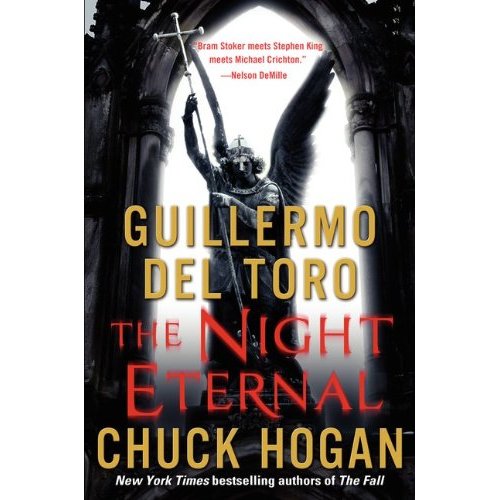
CBR IV: Read Free or Cannonball Hard, Entry 1: “The Night Eternal” by Guillermo Del Toro and Chuck Hogan

(Many thanks to the fine people at Harper Collins, specifically Shawn Nicholls, for providing me with an Advanced Reader Copy of the book I’m about to review. It’s because of people like this that I am a literary addict of the highest regard.)

A warning before we proceed, there are obvious spoilers to "The Strain" and "The Fall" in this review, so read those two beforehand or proceed with caution.  That said, it’s time to resurrect the phrase, “It’s gonna be Biblical”. It used to mean something so epic and awesome that only the Good Book itself could have dreamed it, but over time its basically become the new "Epic".  That is, until Guillermo Del Toro and Chuck Hogan wrote the concluding chapter to their Strain Trilogy, "The Night Eternal".  After reading this book, the term retains its full relevance, and dares modern horror writers to follow in their footsteps.

When we last left Dr. Ephraim "Eph" Goodweather and his band of vampire slayers, the world was nuked to shit.  Sunlight is precious and scarce, and thanks to The Stoneheart Group's sleeper infrastructure taking power, humans are now a harvested quantity.  Blood farms, required donations, enforced curfews, re-runs, and B-Positive breeding programs are the way of the world.  And all that stand in the way of the complete domination of humanity is Goodweather and his team.  It's not going to be easy though as Eph's leadership is called into question (thanks to a newly formed dependency on drugs and alcohol) and the rise of one Vasilly Fet.  Yes, Setrakian's favored exterminator is now not only the wiser looking man in the room, he's shacking up with Nora (whom Eph was still rather sweet on, but began to become distant towards).  Meanwhile, The Master is grooming Eph's beloved son, Zachery (who, as we know, was abducted by Eph's vamped out ex-wife at the end of The Fall), into his new vessel.  This grooming process is carried out through blood bonding to treat the young boy's asthma; as well as a new life of spoiled privilege that changes Zach's outlook on humanity and life itself.   As father and son move towards a possibly fateful reconciliation, Fet uses his new found academic drive to make the moves necessary to bring the game between Vampires and humans to a most explosive endgame.

The key piece in the game, the one thing that everyone is making a move towards is The Occido Lumen, the book that details the Biblical origins of vampirism, and the story of Mr. Quinlan...the second vampire to be created after The Master himself.  Within the book lie secrets to the fabled "black site" that created The Master, and will end him if taken out with a nuclear pulse.

The Night Eternal brings the trilogy started with The Strain to a satisfying conclusion.  As with the previous two entries in the series, the back and forth between the Occido Lumen's story of vampirism's origins and the main story of Goodweather and Company trying to defeat the vampire menace works like a charm.  If anything, I would be thrilled if Mr. Quinlan's story could be further explored, and more tales of the Occido Lumen could be told.  This series has a high potential for spin offs that wouldn't feel cheap.  The ending overall is especially impressive, by pulling off what I knew they'd have to do in order to end the series and pulling no punches.  It ends the way it should, it doesn't cop out, and it gives a hopeful yet bittersweet close to what I've been obsessing and begging William Morrow for advanced copies for over the past two years.

I want Del Toro and Hogan to write more books together, hell I wouldn't mind Del Toro going solo from this point on either.  The storytelling that has gone into this series has been an exact match for the scale that the cover blurb from Nelson DeMille promises: "Bram Stoker meets Stephen King meets Michael Crichton".  I know I've drawn attention to this fact before, but honestly it's the best way to describe the blend of styles in the plot.  So really, you're getting five authors for the price of two.  (This is a bargain already.)

So William Morrow/Harper Collins, I just want to say THANK YOU for letting me cover this journey with you.  And thank you Shawn Nicholls for dealing with my constant nagging/inquiring about when the next book would be out, and when Review Copies would be issued.  It's been worth the time, the effort, and all the time plugging my nose into the books.

Next Up: "The Fault In Our Stars" by John Green

Friday, March 9, 2012

The Cannonball Read IV (AKA Read Free or Cannonball Hard) - Prologue

Well, after an unplanned leave of absence called life, I'm back in the saddle for another Cannonball Read.  Yes, I haven't performed so hotly in these contests, however I still enjoy participating.  Not only does this promote literacy and make reading look fun (and sexy, if you've seen the unofficial mascot on this year's sign up page and have proclivities towards one Michael Fassbender); it also helps us Pajibans remember and honor our dear friend Ms. Alabama Pink, who was taken from her family and friends all too soon by the scourge of Cancer.

So, with her noble, warrior queen spirit in memory; and a shit load of literature planned out ahead of us; it's on.  My unofficial mascot this year is none other than everyone's favorite cop from New York, John McClane; and this year's unofficial title is "Read Free or Cannonball Hard".  With everything in place, and at least three reviews coming in the next couple of days, time to start things off with an old rallying cry...

Saturday, August 6, 2011

The Cannonball Read III - Osaka Slide: #11 - Carte Blanche by Jeffery Deaver

Full Disclosure: I've been lax with my disclaimers.  I really should be including these with my posts on books I received for free.  Not only is it legally expected, it's also just good form.  I'd like to thank Heidi Metcalfe at Harper Collins for providing me with a copy of Men, Women, and Children; as well as Alicia Samuel at Simon and Schuster for providing me with the review copy of this very book under review.

Blame my father for making me a James Bond fan.  He owned all the movies, and ever since he was a kid he'd been a big fan.  If it wasn't for him owning the movies, I'd have thought that 007 was a rather neat video game character, instead of a cinematic icon of suavity and danger.  And if it wasn't for the films, I'd have never taken enough interest to start collecting and reading the Bond books over the years, which would have meant I'd missed out on being introduced to Ian Fleming's sterling prose.  Which would mean that I wouldn't be able to tell the difference between the quality of this book versus the previous attempt at resurrecting Bond, Devil May Care, as compared to the Fleming texts.

Devil May Care was a disaster.  A formulaic fill in the numbers "tribute" to Ian Fleming's writing, that failed to capture me the way Fleming himself did upon the first read.  Truthfully, the only reason I own the book is for completion sake.  When I heard Carte Blanche was coming up, I seized the opportunity because I figured that if it was good, my faith would be restored.  (And if it was bad, then I'd have a good time writing a negatively scathing review.)  I am happy to announce that Carte Blanche succeeds in rebooting the franchise, and giving us readers something to look forward to.  James Bond truly is back.

Bond, now a veteran of the war in Afghanistan, is a young 00 agent at the Overseas Development Group (ODG for short), a front for an organization loosely connected to MI6.  If Six needs something done, but has its hands tied with the regulations, the ODG's O-Section goes to work with their carte blanche privileges.  So long as it's overseas, it's theirs to do whatever they need to in order to get the job done.  It is with this directive that our favorite agent of mystery and intrigue hops the globe in order to avert a disaster only known as Incident Twenty.  It's set to happen in five days time, and James Bond will not only have to outsmart the enemy, but also bureaucratic hurdles within his own government, to stop the man who's at the head of it all...recycling magnate Severin Hydt.

This is the first Deaver book I've read and honestly after reading what he did with Bond, I ran out and picked up a copy of his other recent release, Edge.  He knows his British slang enough to be convincing, he knows the economy of story masterfully enough to keep the book moving at a thrilling pace, and he knows the Bond formula enough to stay true when he has to and to innovate when the audience wants to.  Literally, reading the last chapter of the book there was a moment I was afraid he'd sink into a typical Bond moment...and he didn't.  He is obviously a fan of the new, gritty Bond reboot films...which also means he is a true Ian Fleming fan.  What's even more impressive is that for an initial installment of a series reboot, Deaver forgoes the typical style of front-loading set-up and short changing actual action.  As far as events are concerned, this reads more like an entry that confidentially trusts its audience knows the world enough that it doesn't have to hold their hand and introduce them to everyone.  It lets them work the room and make its own introductions.  It's a Bond book written by a Bond author.

It's rare that I gush over a book this much.  Usually it's in the middle, with a couple quibbles here and there.  Frankly, I can't think of any quibbles with this book at the moment.  I think it's because the Bond formula is so comfortable that it's ok to follow it.  However, in order for it to truly work, you need to put your own spin on it.  Deaver does just that, and he does it admirably.  If there's justice in the world of Spies, Simon and Schuster will continue to produce Bond novels with Deaver at the helm.  Here's hoping that as always...

James Bond Will Return

Up Next: The Magician King by Lev Grossman

Tuesday, June 7, 2011

The Cannonball Read III - Osaka Slide: #10 - Men, Women, and Children by Chad Kultgen

Rarely does an audience get to witness the evolution of a writer, and rarely is such an evolution carried out so artfully.  With most authors settling into a niche or a particular way of telling a story, it's so easy to just do what you've been doing.  While the subject matter of Men, Women & Children: A Novel isn't new to Chad Kultgen, the scope of the story is.  With The Average American Male: A Novel, Kultgen started with first person, singular focus.  With The Lie: A Novel, he stayed with first person storytelling, but told the stories of three different characters.  With Men, Women & Children: A Novel, he makes the jump to the third person and utilizes even more characters.  Even more of a change of pace is the fact that instead of using characters that are college aged, he decides to explore his recurring themes of sexuality (and its influence on social interaction) with the two demographics he's steered clear of...Middle Schoolers and Middle Agers.  The result might be a little uneven (and a little underwhelming when compared to The Lie: A Novel) and a little redundant (when compared to the themes of Tom Perrotta's Little Children: A Novel) but nevertheless this new work shows that it's an exciting time to be a Kultgen fan.

Through the course of a school Football season we are told the stories of five families: the Mooneys, the Trubys, the Beltmeyers, the Clints, and the Vances.  Each family has their own story and their own issues to deal with.  The Mooneys are a Father and Son who are (in their own ways) dealing with the divorce/departure of the Mother in the family.  The Trubys have grown sexually stale and ultimately start to think about infidelity.  Mrs. Beltmeyer has a tight grip on her daughter Brandy, though not as tightly as she'd like; while Mrs. Clint seems to be the polar opposite of Mrs. Beltmeyer in terms of her daughter's interactions.  Finally, the Vances are having that age old debate: to vasectomy or not to vasectomy.  Through all of these stories, there is one connecting thread...the theme of sexuality and the Internet.  Each family in their own way touches on how computing in the modern age has made us more accessible, while making us drift more apart.  People have affairs through websites, children (and sometimes their parents) post provocative pictures of themselves on the Net for all to see, and Sexting is a second language.  All modern times for modern problems, and Kultgen doesn't shy away from being able to transition from one story to another, even intermingling some of his threads into each other.

Which brings up the ultimate criticism when evaluating this book:  it's about high time for Kultgen to either turn this novel into a franchise, or start with a new canvas and tell an epic story, particularly because this book seems to just end out of nowhere.  This is still a good book, but again it ultimately pales in comparison with The Lie: A Novel, particularly because Men, Women & Children: A Novel feels it could go on for another fifty pages and finish out the school year.  It most likely does so because the author has built a reputation for not letting any of his characters get out clean.  This reputation pretty much leads the reader to automatically assume that by the end of the course of events, there will be blood on everyone's hands.  Indeed, the final scene of the book is something akin to a P.T. Anderson film.  It ends abruptly, and with a shock; which ultimately makes for a finished product that feels like it's leading to another installment.

Another difference between this book and the author's previous work is that there's actually a pair of characters you want to see make it out with a measure of happiness.  The fact that he let them get away with the happiness they did is the only real aspect of this book that kicks the reader in the shin, otherwise everyone pretty much does what his previous protagonists have done.  Hearts and minds are broken, sadness prevails over sentimentality, and in the end everyone continues to cope with themselves.  Overall, it's par for the course; while at the same time it shows off just how versatile of an author Kultgen really is.

Up Next: Carte Blanche by Jeffrey Deaver

Tuesday, May 3, 2011

The Cannonball Read III - Osaka Slide: #9 - Pygmy by Chuck Palahniuk

Note: This is the second of five reviews in the Author Appreciation series, which is currently showcasing the work of Chuck Palahniuk.

Pygmy is probably one of the most brutal openers a book could ever deliver.  Within the first 19 pages we're introduced to our anti-hero character of no name (Pygmy is the handle folks around those parts brand him with) who is part of a sleeper cell of agents assigned with nothing short of the destruction of America.  Operation Havoc is their end game, an attack that will throw the nation into its final throes.  Millions are to be killed, and the entire culture subverted by any means nessicary. One major problem standing in their way...they're only about 13 years old.  The source of the brutality? Our main character (one of those 13 year old spies), who has just violated someone in a way that cannot be described in polite company.


While the dust jacket says it's, "The Manchurian Candidate meets South Park", I'd like to suggest that it's more along the lines of Fight Club meets Pinky and the Brain. (A lot of the humor is derived from Pygmy's broken English observations of our culture and our interactions with each other.)  Palahniuk has basically taken Tyler Durden's appetite for social destruction and married it to The Brain's constant mindset of, "God, what are these idiots around me doing?  I better play along, lest my true intentions be known".  It is with that combination in play that our protagonist leads us on an operation that evokes the memory of a not too dissimilar "Project Mayhem", except with fewer soliders and no bitch tits.

As a matter of fact, one could easily think of  Pygmyas the illegitimate sequel to Fight Club, something that the book can both trumpet and be less than proud of.  Even with its younger characters, alternate setting, and even the presense of a detailed backstory for our comrade of glorious revolution; it still manages to sometimes come off as Jack's Smirking Revenge part II.  One could even argue that Palahniuk has this obsession with tearing the walls of Humanity apart commercial by commercial, and leaving it to fend for itself in a barren wasteland where once was a proud people.  But that's only if you let yourself get caught up in the trap of comparison.  Similarities aside, this is still a work that's relevant to our modern times.  Even more so now as we wrestle with the logic of just what makes a terrorist, what makes a Freedom Fighter, and when we should celebrate or mourn their death.  (Be it literal or symbolic.)  Rest assured, this is an entertaining read where you will laugh, you will be offended, and you will sympathize with the enemy.

Up Next: Book Two in the Palahniuk Appreciation Series, Haunted

Monday, April 25, 2011

The Cannonball Read III - Osaka Slide: #8 - Snuff by Chuck Palahniuk

Note: This is the first of five reviews in the Author Appreciation series, which is currently showcasing the work of Chuck Palahniuk.

It's so good to be reading Palahniuk again.  Honestly, the man's one of the best authors of his time and he continues to be consistently entertaining, whether he blows your mind or doesn't.  That's not saying that his non-mind blowing works are less inferior, it's just that Chuck focuses on one of two things: the characters or the plot.  Snuff is one of those books where he focuses more on the characters, and in his doing so he makes the actual plotting seem more interesting than it would under more traditional story telling methods.

Cassie Wright wants to die...or at least that's what it seems like when she agrees to film a 600 man gang bang in a bid to secure her position in the annals of Porn Star history.  What began with a casting call lead to a room of 600 guys standing around: primping, preening, preparing, and waiting for their shot with Ms. Wright.  Throughout the day's events we're privy to four perspectives:

- Mr. 600, aka Branch Bacardi: One of Cassie's former co-stars, also looking for a boost.
- Mr. 137, aka Dan Banyan: A washed out TV star who wants to jump start his career after some sordid rumors.
- Mr. 72: a kid wants to save his mother...who's performing in the room upstairs from him.
- Sheila: the talent wrangler who put this whole show together.

Each individual contributes a rather interesting piece to the overall plot of the book, which isn't all that complex, really.  Where the complexity, and the beauty of the story, comes in is with the characters.  We see Mr. 600 reminisce about the old days and how he deals with aging.  Mr. 72's coming to terms with some rather messed up family issues, and ultimately try to resolve the impotence caused by them.  Mr. 137 talks about how fame's fickle finger found him, and how it threatens to leave him due to his life choices to chase it.  And Sheila...well Sheila's the only person who knows what's really going on, and she's playing it close to the clipboard.  Through these four people, we get to know Cassie Wright.  Her life, her times, and her ultimate place in history. 

Palahniuk knows how to write for multiple voices just as well as he does with his stories that deal with a singular protagonist.  Instead of one person's emotional baggage, we get that of four people.  Four people who constantly interlock and collide as they vie for their own personal moment of fame, which will contribute to Ms. Wright's very own fame itself.  The author explores the themes of fame and aging, as well as just how screwed up your family can make you, in parallel tracks that run at the same time, but ultimately collide in the end.  The wisdom of our parents influences us to do the things we do in life, and not only does Chuck see this, but he exploits it for all of its darkly comedic and dramatic worth.  If anything, this feels like Palahniuk's most sentimental work since I read Choke, the only difference being it eases up on the darkly comedic and veers a little more towards the dramatic.  It's not a mind blower, but Snuff is still an entertaining examination on the twisted condition that is fame, and just what it does to us (and those around us) in the long run.

Up Next: Book Two in the Palahniuk Appreciation Series, Pygmy

Wednesday, April 20, 2011

Coming Soon: The Epic Summer of 2011!


Ah Summer, the time of surf, skirts, sand, and sweltering heat.  It's also the time of the year that everyone is most relaxed and at the same time most energetic.

What better way to commemorate the Summer than to have another special reading project!  From June 1st until August 31st, it's going to be nothing but epics here at TBK.  For the sake of tracking, here's my definition of an epic:

"A huge story, sprawling wide expanses of distance, time, and/or cast, that is AT LEAST 700 pages."

That in mind, throughout those three months I will be reading nothing but epics.  (Except for a couple of possible comic breaks and the latest Chad Kultgen and Lev Grossman releases.  Have to stay timely somehow.)  There isn't a definitive schedule in the works, but the three tentpoles that are going to hold this marathon up are:

The Passage: A Novel

Infinite Jest


Gone With the Wind

Other than that I've been considering others such as The Stand, A Game of Thrones, Under The Dome, and Drood.  (However, suggestions are welcome for entries in this epic undertaking.)  Epic Summer becomes Epic on June 1st.

Wednesday, April 13, 2011

The Cannonball Read III - Osaka Slide: #7 - The Secret Year by Jennifer R. Hubbard

This isn't Kings of Colorado, I know.  After overloading myself with Jersey Shore literature, I could hardly settle myself into a story of redemption through horses and hard time.  So I moved onto JWoww's book, in hopes that I may slay that beast and be done with the Jersey Shore kids for good.  That didn't happen either.  I couldn't even get through James Franco's short story collection, due to the fatigue I had put myself through.  After the sprint I'd done for the beginning of this quest, I needed something simple.  Something light that would alleviate me of the weight that I had taken on.  In the words of a good friend of mine, I needed something borderline trashy.  What I went with was The Secret Year: a book that's not so much trashy as it is steamy, and even then it is mildly so.

Undoubtedly there is sex in the book, but it's not so smutty that you need to take a shower after reading it.  Our narrator throughout the story is Colten "Colt" Morrissey, a teenage boy who confides to the audience about his secret year long relationship with Julia Vernon.  It's not that Colt and Julia don't like each other, it's just that Colt comes from the poor side of town and Julia is from the rich side.  Now before you say, "Hey, I've read this book before", the book's description itself even sells the book as follows:

"Take Romeo and Juliet. Add The Outsiders. Mix thoroughly."

It's the perfect summary for the story that unfolds as Colt recalls the events that occurred after Julia's death in a drunk driving accident.  Shortly after her funeral, he receives her secret diary, consisting of letters all written out to him.  These letters give Colt insight into what Julia was thinking about during the span of their relationship, as well as how she really felt about him.  What he sees is a portrait of a girl uncertain as to whether she should stay with the boy she truly loves, or continue to date her boyfriend.  As Colt reads on into Julia's thoughts, personal developments end up spurring sociological developments, culminating in a big "rumble" towards the end of the book.

Which is precisely why I can say I like the book, but I don't love it.  For starters, The Secret Year really sells itself on the love story aspect, when it really comes off as a more uneven blend of Hintonesque social tension and romantic entanglements.  That's not to say that the book isn't an enjoyable read, but it's not exactly the most consistent in tone and story.  Also, the book moves so fast that by the end of the novel, I was expecting at least another 10 to 20 pages wrapping things up.  Instead, the book just kind of ends, which is fine if you're trying to use that as a metaphor for the fleeting nature of Julia's life.  By the end of the book, it's as if we truly are in Colten's shoes: we've hit the end of the text, we want to know more about what we've just finished reading, and we're surprised it ended so abruptly. 

The Secret Year starts with a forbidden love, but ends with a rumble, and somehow two plot lines feel like they should have been separated into their own books in order to truly flourish.  It would be nice if Ms. Hubbard could revisit this world, because while it isn't the most polished product (it is a debut novel, after all), it has enough flashes of depth that it would be fun to see her further hone her craft and deliver more tails of The Black Mountain kids and The Flats kids.  If anything, I would like to see her give a little more resolution to poor Colt, because the kid deserves it.

Up Next: Author Appreciation Marathon #1- Chuck Palahniuk.  In no particular order...
 - Snuff